Over the years I’ve written, used and accumulated a lot of classroom materials, some of which I thought other teachers might find useful. Hence this blog!
A little bit about me. I’ve been teaching since 1991, most of that time in Barcelona. I work at the Escola d’Idiomes Moderns of the University of Barcelona as a CELTA trainer, EFL teacher and head of Teacher Training. To find out more, please visit the About section.
All the materials on this site are tried-and-tested, but bear in mind that they have been produced to use in a general adult EFL context in Spain. Please feel free to adapt the activities to use with learners of different L1s and different age groups. I’d love to hear your feedback, so please leave a comment.
I’ve just come back from the annual TESOL Spain convention in Burgos brimming with ideas! It really is a fantastic event and all credit to the organisers and dedicated volunteers who made it possible.
Unsurprisingly, AI – and its applications in the classroom – was one of the major themes this year. I am a good litmus test for any kind of AI activity. If I can do it, anyone can! This is an idea taken from Catherine Morley’s Keynote session on Saturday, 16th March. I’m sure plenty of you are already using it, but in case you’re not (like me) thank you to Catherine for introducing me to it.
The Twee platform can help you generate a text on the topic and level of your choice, including target vocabulary and follow-up activities to exploit the text for meaning and language.
Go to Twee and create a free account – it’s very simple.
Once you’ve logged in, you see a menu – some options are free, some are ‘Pro’.
3. Choose the option ‘Create a Text on Any Topic with Your Vocabulary:
4. In the following section, you can choose the Topic, Target Vocabulary, CEFR Level, Genre and Length Range. I chose the following:
TOPIC: Tourism
TARGET VOCABULARY: overcrowded, strain on resources, protests from locals, cruise ships, infrastructure, income, economic importance
LEVEL: B2
GENRE: Argumentative article
LENGTH RANGE: 250-350
5. Then click on ‘Do the magic’ and wait for the text to be generated
Here is the text that it generated:
You have the option of shortening the text if it is too long (button at end of text) and copying it to the clipboard (top-right corner) in case you want to use it later
Once you’ve generated your text, you can ask Twee to create comprehension questions – using the option ‘ABCD questions’ from the menu below.
This created seven multiple-choice comprehsnion questions for the text above at B2 level. Here are a couple of examples:
7. Exploiting the text for language. Twee also offers you various follow-up activities. Here’s a sample of the options available for the target vocabulary in the text:
Here’s a sample (not complete) from the word-definition matching activity using the target vocabulary
8. Once you’ve created your text and activities, you can assign it to your students (especially good for online classes). In the top menu, use the ‘Assign’ option to create a link which you can send to students. They don’t have to create an account to use the platform!
9. You can see students’ results in ‘My Lessons’ on the main Twee page
*Twee is quick, intuitive and easy to use, but – as with any content created by AI – the result may not be immediately perfect. The teacher will need to fact-check and review the text and activities for the usual issues: bias, fact-checking, correct references etc.
Then you’ll need to check/adapt the activities to make them appropriate for your students.
Earlier this year, I was lucky enough to attend the Psychology of Language Learning Conference in Madrid. One of the talks I went to was a workshop by Ashleigh Pipes (University of Tennessee, USA): ‘Embracing Creativity as an Individual Difference in SLA’. She presented interesting evidence that successful second language acquisition is linked to creativity, and related skills such as divergent thinking and problem solving. Therefore, as language teachers, we should be giving creativity as much attention as we do other individual differences such as motivation or aptitude.
Ashleigh Pipes presenting at the PLL5 conference in Madrid, May 2024.
Not only is this an interesting area for research, but it lends itself easily to classroom activities. Ashleigh tried a couple of these, taken from the Torrance Tests of Creative Thinking, with us in the workshop. I’ve since tried them out with students and they meet the following criteria:
materials-light (or free!)
easy and simple to set up
fun for students (they get to analyse themselves)
generate lots of discussion
In the next couple of posts, I’ll be sharing a couple of ideas taken from this workshop. These may not be new – but worth revisiting! There are classroom resource books to help develop creativity, e.g. The Creative Teacher’s Compendium (Marsh, A. & Clare, A, Pavilion ELT, 2021). If you are interested in looking into the background and research in this area in more depth, I would recommend Ashleigh’s book: Researching Creativity in Second Language Acquisition (Routledge, 2023)
Summary
These activities are designed to be done individually, and then act as a spingboard to classroom discussion.
How creative are you? – learners do one of the tasks from the Torrance Test to find out their own level of creativity and then discuss the results.
The Paper Clip Test – a classic test of creativty, that needs no prep or materials! Students have to think of as many different uses for a paper clip as they can! Simple but generates lots of (sometimes heated) discussion.
Materials
A pdf with teacher’s instructions and key for each of these activities can be downloaded. There is a downloadable handout for ‘How creative are you?’. The ‘Paper Clip Test’ is materials free!
Hope you – and your students – enjoy them and let me know how it goes!
It’s that time of year again. Publishers and teaching organisations are providing a wealth of free online training opportunities to coincide with the start of the new academic year (for those of us in the northern hemisphere).
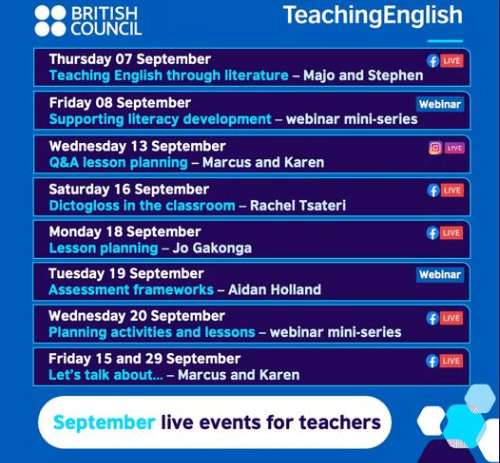
It’s hard to keep track, so I’ve compiled a list of some of the webinars and online events coming up this month. You’ll find them by order of date. Most are in English, but I’ve also included other languages (Spanish, French and Catalan).
Of course I will have missed something! If you know of another training opportunity that you think will be useful to share with other teachers, please post a link in the comments.
Have a great start to the year!
——————————–
7 – 29 September ENGLISH
TEACHING ENGLISH LIVE EVENTS (British Council)
Live Online (Free)
Facebook Live events throughout September. If you are on Facebook, search TeachingEnglish British Council. For webinars, see links provided for individual events below.
——————————–
Tues, 12th Sep. 12.00 – 13.00 (UK time)
PLANNING EFFECTIVE CONTINUING PROFESSIONAL DEVELOPMENT PROGRAMMES FOR TEACHERS – KEY PRINCIPLES.
(British Council)
Free webinar Join us on 12 September for an exploration of the essential underlying principles of planning professional development for teachers.
Who is this webinar for? Please note the content of this webinar is not aimed at teachers, and is specifically for teacher educators who have a role in supporting the professional development of English language teachers.
What is this webinar about? It is important for teachers to have opportunities for professional development, but what can we do to make these opportunities as effective as possible? In this webinar, ELT teacher development specialist Simon Borg draws on his academic and practical experience to discuss a number of principles that guide the design, delivery and evaluation of effective CPD programmes.
By the end of the webinar, our audience of teacher educators should have gained knowledge and practical advice on how these principles can be applied in their work.
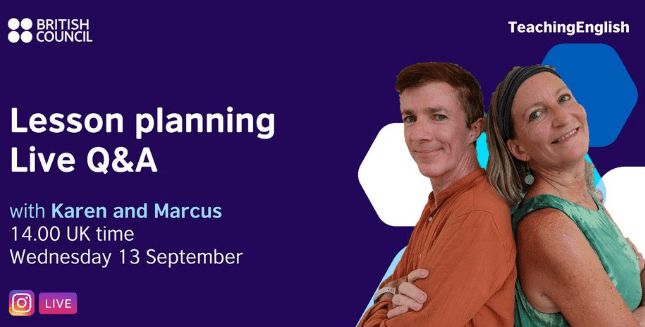
Have you got questions about lesson planning? In this live event, Marcus and Karen from the @britishcouncil #TeachingEnglish programme invite teachers to ask questions and we’ll try our best to offer our advice. Event live on Instagram. Search teachingenglish.britishcouncil
——————————–
Mercredi, 13 Sep. 17.00 – 18.0 (GMT +1) FRANÇAIS
ORGANISER UN CONCOURS DE LECTURE ET D’ÉCRITURE EN CLASSE DE FLE (Groupe Hatier International)
Atelier en ligne
A propos Vous êtes tenté par la pédagogie de projet ? Suivez ce webinaire pour découvrir de nombreuses idées et ressources pour organiser un concours de lecture et d’écriture. Le cas d’étude utilisé pour ce projet pédagogique sera en classe de FLE pour le niveau A1. S’inscrire
——————————–
Miércoles 13 Septiembre – 17:00 ESPAÑOL
MESA REDONDA NEBRIJA – DIFUSIÓN DESAFÍOS EN LA DIDÁCTICA Y LA INVESTIGACIÓN EN ELE
Modalidad Híbrida Vivimos, enseñamos y aprendemos en un entorno cambiante a un ritmo apresurado, caracterizado por la evolución de la investigación y la tecnología, la glocalización de mercados y culturas, los movimientos migratorios, el multilingüismo y la pluriculturalidad, la diversidad y la búsqueda de la sostenibilidad. ¿Cómo nos situamos ante semejante escenario como profesionales de la didáctica del español como nueva lengua? ¿Qué retos y oportunidades se nos brindan?
Te proponemos comenzar el nuevo curso con una reflexión conjunta y compartida. Envíanos tus preguntas con el hashtag #DesafíosELE y acompáñanos en la mesa redonda del próximo 13 de septiembre (17:00-19:00 hora peninsular española) para escuchar las respuestas de la mano de Carmen Pastor Villalba (Directora académica del Instituto Cervantes), Susana Martín Leralta (Decana de la Facultad de Lenguas y Educación de la Universidad Nebrija), Liliana Paredes (Directora del Centro de Estudios Latinoamericanos y Caribeños de Duke University) y Agustín Garmendia (Director de Edición Internacional de la editorial Difusión). Nuestros ponentes debatirán las cuestiones recibidas sobre las siguientes líneas:
Te esperamos en el Campus de la Universidad Nebrija de Arturo Soria (C/ Asura 90, Madrid) o por streaming a través de Zoom. Inscripción gratuita imprescindible.
Thurs. 14th Sep. 11am (mainland Spain / CEST / UTC+2). ENGLISH
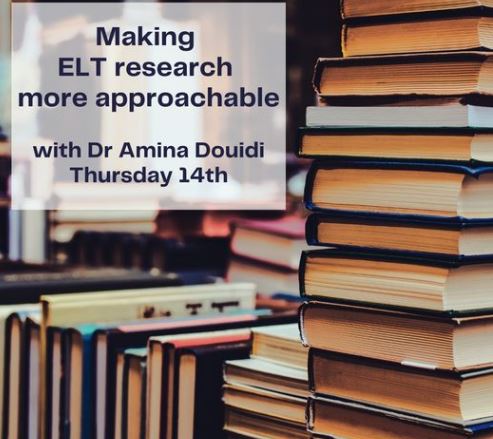
MAKING ELT RESEARCH MORE APPROACHABLE
(TEFL Development Hub)
Facebook live session
ELT RESEARCH | I would call myself a non-academic, so I’m really excited about next week’s livestream 🤓 The amazing Amina Douidi will be joining us to chat about how to make ELT research more approachable. She’ll be sharing tips on where to find resources, how to read an academic text more effectively and which AI tools can help. We’ll be live here in the Hub on Thursday 14th at 11am (mainland Spain / CEST / UTC+2).
Search Teresa Bestwick / TEFL Development Hub on Facebook
——————————–
Sat. 16th Sep. 14.00 – 14.30 UTC + 02 ENGLISH
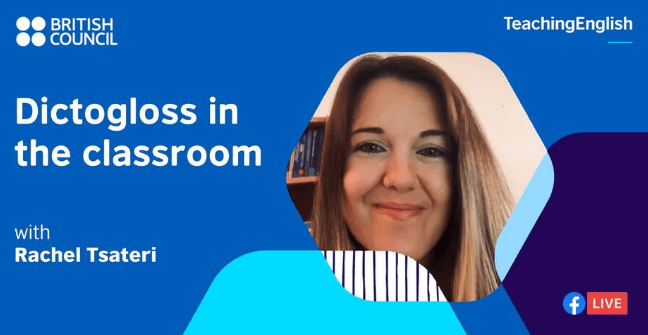
DICTOGLOSS IN THE CLASSROOM (British Council)
Free Facebook live event
Dictogloss is a classroom dictation activity where learners are required to reconstruct a short text by listening and noting down key words, which are then used as a base for reconstruction. In this live and interactive community event for teachers of English, Rachel Tsateri will be sharing some activity ideas that uses fun dictation to break the ice and get to know each other. Perfect for the beginning of term. Rachel Tsateri is a freelance teacher, trainer, and blogger (The TEFL Zone).
Search Facebook: British Council Teaching English
——————————–
18-25 September 2023 | 11:00 & 17:30 CET
GETTING STARTED WITH CAMBRIDGE
(Cambridge University Press & Assessment)
Join us for this exciting four-day event where we’ll meet some of the most inspiring names in English language teaching who will share their insights for the start of the school year!
18 September Pre-Primary Karen Elliot
19 September Young learners Olha Madylus
21 September Exams Claire Ross
25 September Teenagers Herbert Puchta
Afterwards, you’ll have the chance to dive into your coursebook with our expert trainers, who will provide you with practical ideas and tips as well as exploring the pedagogy behind the course.
There will be morning and afternoon sessions each day at 11:00 and 17:30 (CET) so that you can choose the time that best fits your busy schedule.
Certificates of attendance will be issued for the plenary talks.
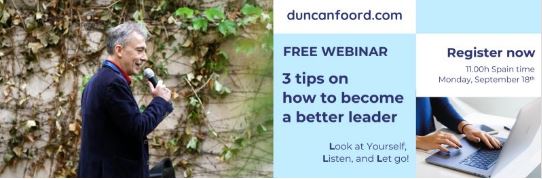
3 TIPS ON HOW TO BECOME A BETTER LEADER. LOOK AT YOURSELF, LISTEN AND LET GO!
(Duncan Foord, Director Oxford TEFL)
This webinar is for you if you are an ELT professional interested in ways to overcome challenges in your working life, such as your motivation, your conversations with others and your ambitions. I will be sharing a few thoughts and practical tools, which will help you support yourself ad the people around you more effectively.
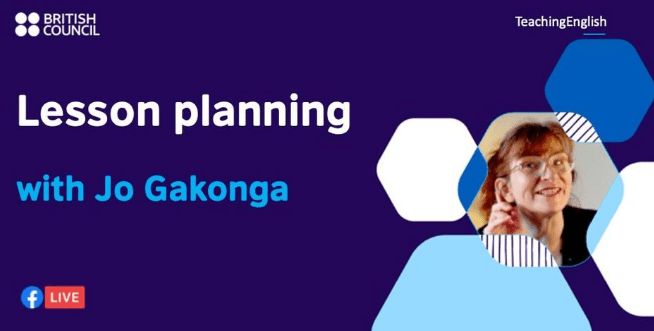
Jo talks about lesson planning, the steps involved and some tips for making the process easier. Jo Gakonga, PhD has worked in ELT for over 30 years in a range of countries and contexts. She’s a teacher educator, CELTA trainer and assessor, co-author of IELTS Foundation and runs a widely acclaimed website at https://www.elt-training.com/ with courses for English language teachers at all stages of their careers.
Search Facebook: British Council Teaching English
——————————–
Tues. 19th Sep. 13.00 ENGLISH
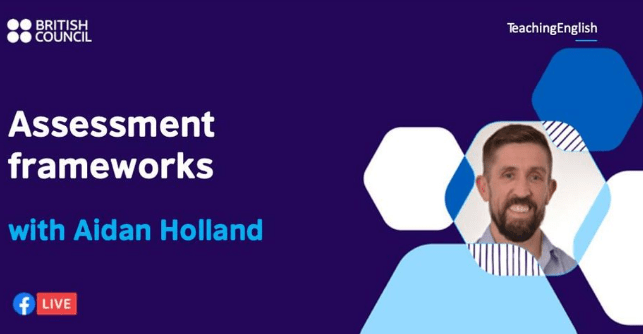
ASSESSMENT FRAMEWORKS (British Council)
Free Facebook live event
Aidan talks about the CEFR level and how teachers can use this framework to assess learners on a range of skills and language areas.
Aidan Holland is working as Manager, Global Assessment Solutions Projects in Wider Europe for the British Council. He has been working for the British Council in a variety of roles since 2009. He has over 20 years international experience in teaching and teacher training and almost a decade of experience in academic management positions. He holds an MA in TEFL/SL from the University of Birmingham and is currently completing a second MA in Language Testing with the University of Lancaster. He is currently based in Spain.
Search Facebook: British Council Teaching English
——————————–
Weds, 20th Sep (07.00 – 19.00, GMT + 1) ENGLISH
GLOBAL PREPARATION CENTRES EVENT, 2023 (Cambridge University Press and Assessment)
Live Online (Free)
Join us online for a day of inspiration and practical advice on how to build your confidence around Cambridge English Qualifications. With expert presenters from around the world and our lively hosts here on the Cambridge campus this global online event brings you inspiration and tools to build your teachers’ and students’ confidence around English qualifications. See how you can grow your institution’s impact and drive your students’ success with Cambridge. If you are an official Preparation Centre for Cambridge English Qualifications, then you are passionate about your students’ success, especially around exam preparation. Join us online for a day full of practical advice on how to build your students’ confidence. Celebrate with us success stories from preparation centres and come away with resources and tools to help you support your teachers and students.
Weds. 20th September. 10.00 – 13.30 (UK time) ENGLISH
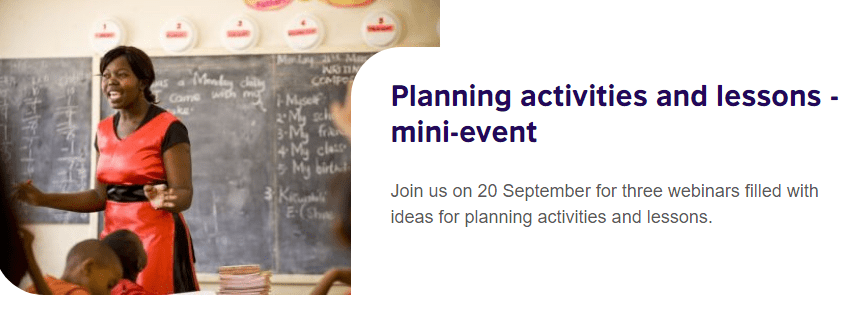
PLANNING ACTIVITIES AND LESSONS – MINI EVENT (British Council)
Live Online (Free)
This one day webinar event will feature three webinars with ELT experts from around the world. Attend up to three webinars on September 20 from 10:00 to 13:30 (UK time). All three webinars will help English teachers think about how they plan activities and lessons. The webinars are for teachers of primary, secondary and young adult English language learners.
Session 1 (10.00 -11.00): Setting up activities and tasks efficiently in 5 steps Speaker: Ela Moyle Session 2 (11.15 – 12.15): Gentle Discipline in classroom management Speaker: Zahra Zuhair Session 3 (12.30 – 13.30): Creating your own learning materials – six easy steps Speaker: Desislava Duridanova
Discover a range of practical, creative teaching ideas and activities from a unique 90-minute dip into our key titles that you can then do with your English classes. In this free 90-minute online event, Kirsten Holt will be sharing a range of practical teaching ideas and activities from a wide spectrum of Pavilion ELT titles, for you to then use with your classes. Plus, you will get exclusive discounts on the featured books during the session!
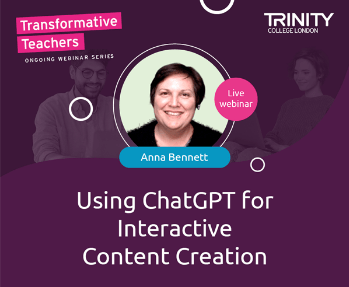
USING ChatGPT FOR INTERACTIVE CONTENT CREATION (Trinity College London)
Live Online (Free)
Presented by: Anna Bennett Join us for an exciting online how-to workshop designed for language teachers who are interested in learning more about how to create learner-centred activities with the aid of ChatGPT. Transformative Teachers – September 2023 Join us for an exciting online how-to workshop designed for language teachers who are interested in learning more about how to create learner-centred activities with the aid of ChatGPT. Teachers will explore the capabilities of ChatGPT and learn how to utilise its conversational AI technology to design dynamic and interactive instructional materials. They will discover how to generate engaging prompts, create adaptive assessments, and facilitate meaningful interactions with students.
Join Radek Krzyżanowski for an exclusive onboarding session and unlock the full potential of Oxford English Hub. Discover cutting-edge innovations and powerful functionalities that will supercharge your English teaching experience. Gain invaluable insights to effortlessly optimize your work with materials and students through the Hub. Don’t miss out on this game-changing opportunity!
BE YOURSELF IN ENGLISH: THE FUTURE OF ENGLISH LANGUAGE LEARNING (Pearson)
Free online
The landscape of language learning is changing. From the technology we use, to the skills we teach and the evolving world around us, staying ahead of the curve can be challenging.
Join our teacher trainers and language experts in this live webinar series to find out how to future-proof your teaching. Discover the latest trends in language learning, how to use them in your classroom and more.
Sign up for free to join live and get your personal development certificate after every session.
25 September 2023: Employability skills: New jobs, new needs for language learners Presenter: Dr. Ken Beatty 26 September 2023: Unlocking the power of AI in language learning Presenter: Damian Beneyto 27 September 2023: Developing language skills and preparing learners for the future Presenter: Billie Jago 28 September 2023: Empowering a more sustainable future in the ELT classroom Presenter: Harry Waters 29 September 2023: Accessibility and diversity: Helping every language learner thrive Presenter: Dr. Amina Douidi
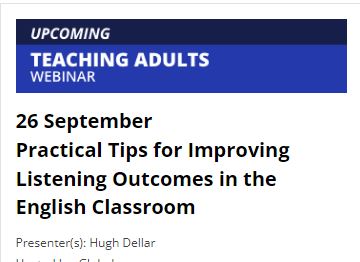
Tues, 26th September 2023. 09.00 (ET) 14.00 (UK Time) ENGLISH
PRACTICAL TIPS FOR IMPROVING LISTENING OUTCOMES IN THE ENGLISH CLASSROOM
(National Geographic Learning)
In this practical, classroom-rooted session, we’ll be looking at what makes good listeners good: knowing language, hearing the language you know, and the ability to automatically match meaning to sounds. Using examples from Outcomes Third Edition, we’ll look at how we can develop these skills through our choice of input, through micro-listening tasks, and more.
Hugh Dellar is a teacher, teacher trainer, and coursebook writer based in London. He has over twenty-five years of experience in the field and is the co-founder of Lexical Lab. He has co-authored two five-level General English series, Outcomes and Innovations, both published by National Geographic Learning, and one level of the high-school series Perspectives.
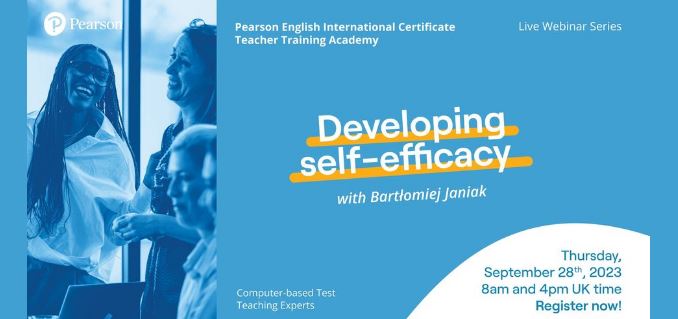
Thurs, 28th September 2023. 08.00 (BST) 16.00 (BST) ENGLISH
DEVELOPING SELF EFFICACY IN LANGUAGE LEARNING.
(Pearson Languages)
oin us for an insightful webinar on ‘Developing Self-Efficacy in Language Learning’. During this session, we’ll delve deep into the concept of self-efficacy. 💪 🤔 What is self-efficacy? 🌱 How can it be nurtured in language learning? 🧐 Should beliefs be reshaped or embraced as is? Don’t miss out on valuable insights from our presenter, Bartłomiej Janiak! 🎙️ 🗓️ Date: September 28th 2023 Register Now: ⏰ 8AM BST https://ow.ly/IW9t50PMG2X ⏰ 4PM BST https://ow.ly/QqN450PMG2Y
It’s been a while! No excuses – but here’s my latest celebration of my love of TV Quiz show Richard Osman’s House of Games.
Who doesn’t love a good trivia quiz? Even better if we can give it a language twist (revision of lexical fields or past tenses). Here are two games adapted from the ROHoG format. For those of you who don’t know, this is a popular teatime quiz show broadcast five evenings a week on BBC2, in which four guests compete in four games per episode. The final game is always the same, but all the other games are different, and many of them are just calling out to be adapted to ELT classrooms.
The host himself has gone from strength to strength recently, meeting his new wife on the show, and seeing his series of detective novels top bestseller lists worldwide. He’s still fronting his eponymous show, now into its 6th season and past its 100th episode, although I don’t know how much longer we’ll have the pleasure of his company. The show maintains some of its classic game formats, but has also added some new ones – including my current favourite ‘There’s no ‘I’ in Osman’, included here.
I’ve prepared a couple of powerpoint presentations as examples, but the questions could just as easily be written on a whiteboard or read out loud. Feel free to use my examples (please credit me!), but obviously if you want to create your own, it requires a little internet research.
These games can be played by individuals. If you want to play as teams, groups of 3-4 work best, with one individual representing the team in each round. You decide if the ‘reps’ can consult their teams – depending on liveliness and noise levels!
Summary
These are both individual or team quizzes, based on general knowledge topics, and/or vocabulary knowledge.
There’s no ‘I’ in Osman – players try to name as many examples of a given category as possible, without using the ‘forbidden’ letter.
Blast from the past – tense – players answer a trivia question, but have to convert it into the past tense. Exercising both general and language knowledge at the same time – quite cognitively challenging.
Materials
A pdf with instructions for both games can be downloaded, as well as an example of each game, which I’ve left in an editable format, so you can adapt and add to them as you please. Hope you – and your students – enjoy them and let me know how it goes!
The British love a good queue, or so we’re told. Differences in queueing etquette around the world can be the cause of misunderstanding and stress. This text, adapted from an online news article in the Guardian newspaper, summarises some of the research done into people’s queueing habits, with some surprising results.
Summary
This activity practises the multiple-matching task in Cambridge First Reading part 7 and acts as a springboard for discussion on queueing habits and cultural differences. This is aimed at students preparing for an exam such as Cambridge First but can be used as a speaking & reading activity with any group at a B2 level or higher. I’ve included the student’s worksheet and teacher’s notes (with lesson plan and key) as separate documents.
This is the third in an occasional series sharing the potential (I hope) of the games in the BBC2 quiz show ‘Richard Osman’s House of Games‘ for EFL classes. In this instalment I share two games which make use of the main classroom whiteboard. In a physical classroom, you need access to a whiteboard or screen and a projector. I’ve only ever played these games with F2F groups, but it should be possible to adapt these to a videoconferencing format using the whiteboard and stickers functions available in platforms such as Zoom.
As usual, I’ve uploaded an example of each game in an editable ppt format. This means the games can be used as they are, or can be downloaded and adapted to fit the vocabulary and themes that you are presenting or recycling.
Summary
Both activities are ‘pin-the-tail-on-the-donkey’ style games, which involve associating vocabulary and cultural knowledge with images. While the basic premise is very simple, this format allows different variations which can expand the language use beyond a simple test of what students know.
Put your finger on it is a game where students identify the correct option from an image projected on the screen.
Where is Kazakhstan? is a geography-based general knowledge game, played in teams.
I’ve provided instructions for both games on one downloadable document and a link to an example of each game in ppt format. I’ve chosen vocabulary and lexical sets that correspond to the context I was teaching, but you can use the ppt as a template to adapt to your own teaching situation and the needs of your learners.
Here’s the second instalment in a series of games based on Richard Osman’s House of Games. In the last post I shared my (slightly obsessive) fondness for this BBC2 quiz show. It turns out I’m not the only one. Here are three more games, all based around recycling previously-presented vocabulary. They can be played individually, or in pairs/teams, with mini-whiteboards, or in live online classes using the chat box or whiteboard to collect answers.
As before, I’ve uploaded the example games in ppt format, so they can be used as they are, or as a template to adapt to vocabulary for your own groups. Given the current situation, the format (I hope) is adaptable to both F2F and live online classes. Let me know what you think!
Summary
The three games in this post require a little preparation, basically identifying the vocabulary to be recycled in each case and adapting the ppt template accordingly. I do recommend you make a note of the answers beforehand, or even better, add slides to the game to show the answers while playing. Some of the games, e.g. Games House Of can catch you out (as I found to my cost) if you’re not prepared.
This Round is in Code is a very simple game, which can be played individually or in pairs or groups. The code is easy to understand, but the answers are not at all obvious!
Games House Of is a challenging game, which involves reproducing lexical chunks in alphabetical order, so only works with sequences of two or more words.
Size Matters is a fun game format, where learners aim to produce the longest (correct!) possible word from a given group . In the original programme, the questions were based on general knowledge, but this has been adapted to be used with lexical sets.
I’ve provided instructions for all three games on one downloadable document below and an example of each game in ppt format, which can be used as an editable template to customise for your own teaching situation and learners.
Like many English teachers, I’m a big fan of word games. I’m also a big fan of the British TV producer and presenter Richard Osman. The Quiz show ‘Richard Osman’s House of Games’ (ROHoG) has been running on BBC 2 for a couple of years. The basic format is that four media personalities take part in a series of games based around language, logic and/or general knowledge. Most of the games are very simple and accessible and I’d been wondering for a long time if it was possible to translate them to the language classroom.
*Update: Fellow fan @eltplanning uses the ROHoG classic ‘Answer Smash’ in class and has blogged about it here.
Then the Coronavirus crisis occurred and my extra-curricular activities were put on hold. After making the move online with my year-long F2F courses, I was then faced with a new challenge: a summer intensive course from scratch taught via Zoom. To break up the routine of daily online classes, I set out to do at least one different game every day to recycle and use vocabulary presented throughout the course. I’d already tried adapting some of the games in my F2F classes and this gave me the opportunity to see if any of the games worked well in an online context. Huge thanks to my group for being such willing and motivated guinea pigs. This is the first in (I hope) a series of posts to share teacher- and learner-friendly ROHoG game formats which worked in both contexts.
Summary
Games for tablets or mini whiteboards.
Here are three games adapted from the ROHoG format which can be used with tablets or mini whiteboards. A blank piece of white paper inside a clear plastic pocket is an easy way to make your own mini whiteboard. If you’re teaching an online class via videoconferencing, the students can hold their boards or pockets up to the camera to play. Give your students advance notice so they can bring or make the mini-whiteboard for the following class.
NB: If using mini-whiteboards, students will also need a tissue or cloth to clean it after each round. Students often have a packet of tissues on them, but if you’re playing in a F2F class, have some extra, just in case.
You Spell Terrible is a game played in pairs which tests both vocabulary knowledge and spelling of ‘problematic’ words.
The Rich List is an individual game, loosely based on the ‘Scattegories‘ board game, where the teacher gets to play too.
Size Matters is a game where learners compete to find the longest possible word within a given category.
I’ve provided instructions for all three games on one downloadable document and, for each game, a link to an example game in ppt format. I’ve chosen vocabulary and lexical sets that correspond to the context I was teaching, but you can use the ppt as a template to adapt to your own teaching situation and the needs of your learners.
Time for a seasonal dose of schmaltz, this year courtesy of Sky/Xfinity TV. I’ll let you (and your learners) decide if it’s a homage to a much-loved childhood classic or something entirely different.
Summary
This is a video based on an advert for a satellite TV company that reunites the characters of Elliott and E.T. from the eponymous film. As there is very little dialogue, the activity can be used at lower levels, to introduce vocabulary related to Christmas, family and nostalgia and, at higher levels, as a springboard for discussion of growing up, change and (potentially) the exploitation of the season. There are both powerpoint and paper versions of the student activities. I’d recommend the ppt format, not only to save paper, but also to make better use of some of the images used to introduce the ad. Exploit the images to elicit the story, characters, actors etc. for those students who may not have seen it (if not, why not?).
This worksheet is designed to be used with the short video ‘Thank a teacher’, which marks the annual ‘World Teachers’ Day’ coming up on October 5th.
Summary
The video and worksheet can be used as a basis for discussion on teachers, education and childhood influences and role models. The video ‘Thank a teacher’ is fairly self-explanatory. I’ve used it with B1 classes, but I think it’s probably more accessible to levels B2 upwards. The follow-up video (Ian Wright), which went viral a couple of years ago, would probably work better at higher levels (C1+).













 EFL Takeaways